Cuprates and the Mott Problem
Why high-temperature superconductivity forced condensed-matter physics to take strong electron correlation seriously — and why the story begins with an insulator that band theory says should be a metal.
Concepts EmergenceStrong correlationsCompeting orders
On this page
This subject grew out of a Master’s thesis — Mott Physics in Correlated Lattices: A Dynamical Mean Field Theory Study (Université Paris-Saclay / LPS) — but it is not a PDF behind a link: every derivation, figure, and result lives on these pages, in full. We start with the experimental puzzle that motivates everything.
From conventional superconductors to a puzzle
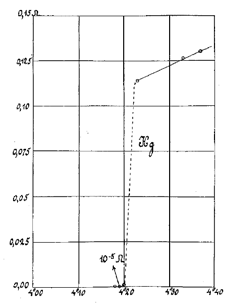
In 1911 Kamerlingh Onnes found that the DC resistivity of mercury drops abruptly to
zero below
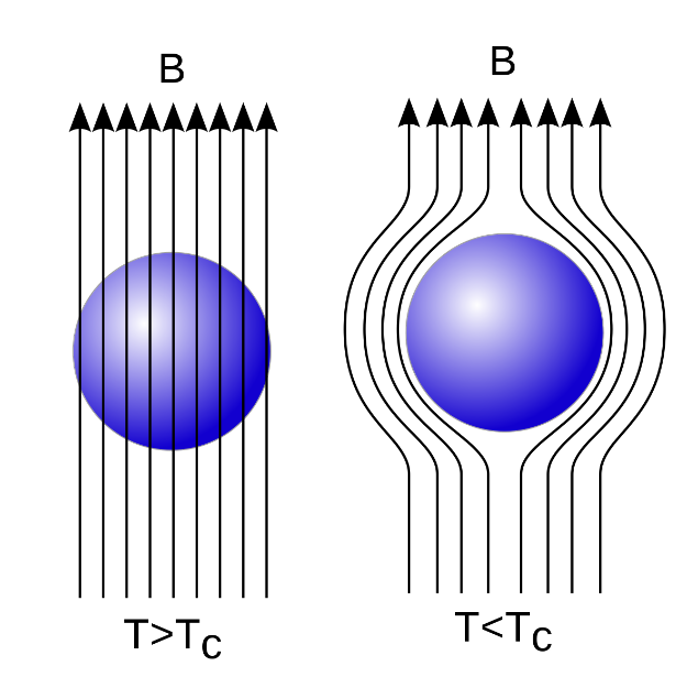
The distinction between bosons and fermions is central here. Particles are classified by the symmetry of the wavefunction under exchange of two identical particles: symmetric for bosons, antisymmetric for fermions. As Pauli first anticipated, half-integer-spin particles are fermions (obeying the exclusion principle), integer-spin particles bosons. Bosons may occupy the same quantum state, so a gas of non-interacting bosons can condense into one ground state — a Bose–Einstein condensate (BEC) — which, with weak interactions, becomes a superfluid that flows without friction. Electrons are fermions and do not condense in this way; but if pairs of electrons form, each composite pair behaves effectively as a boson and can condense. The puzzle is that electrons repel through the Coulomb interaction — so how do they pair at all? The answer lies in the crystal lattice we have so far neglected.
These conventional superconductors are explained by BCS theory. Its
phenomenological core: although electrons repel through the Coulomb interaction, the
crystal lattice mediates an effective attraction between them via phonons. The
isotope effect —
High-
In 1986 Bednorz and Müller found superconductivity near
Crucially, the parent compound is not a metal but an insulator — a Mott
insulator — in flat contradiction with the conventional band theory of solids.
High-
Cuprates: structure and phase diagram
Cuprates share a layered structure:
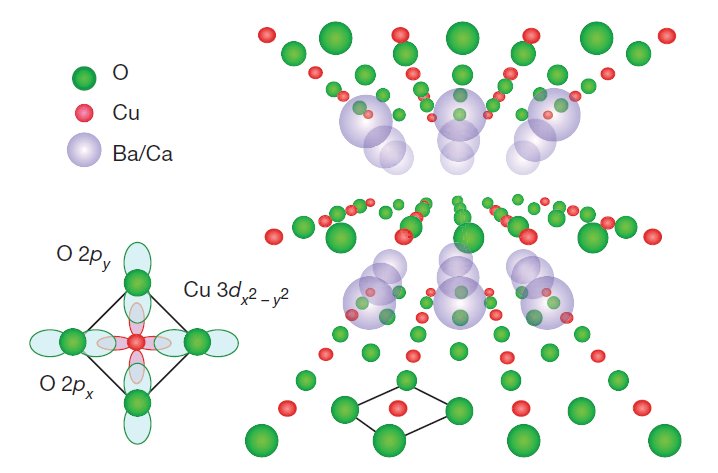
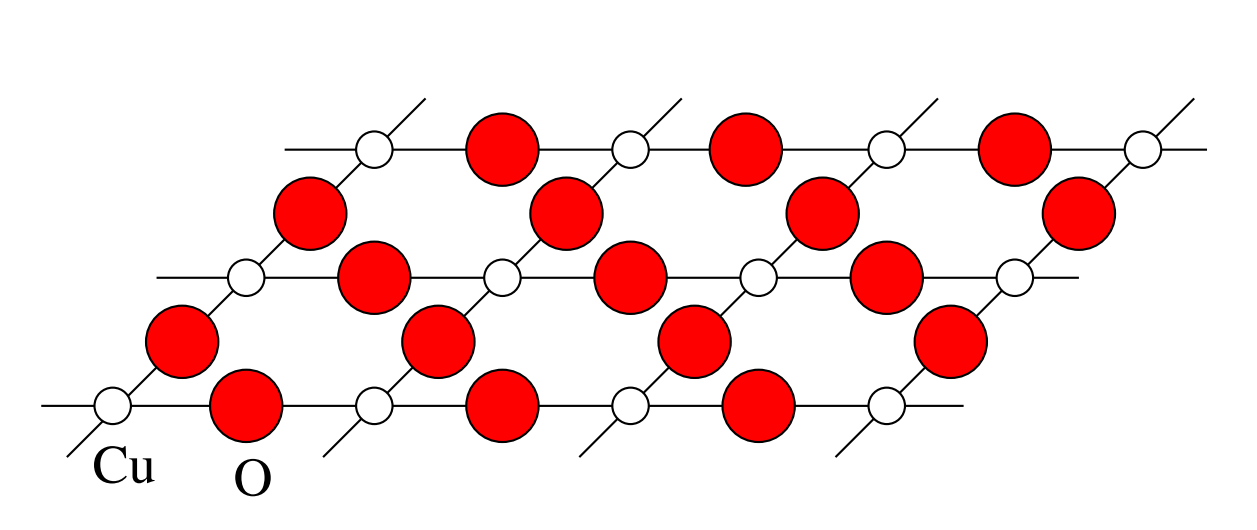
Each copper hosts a
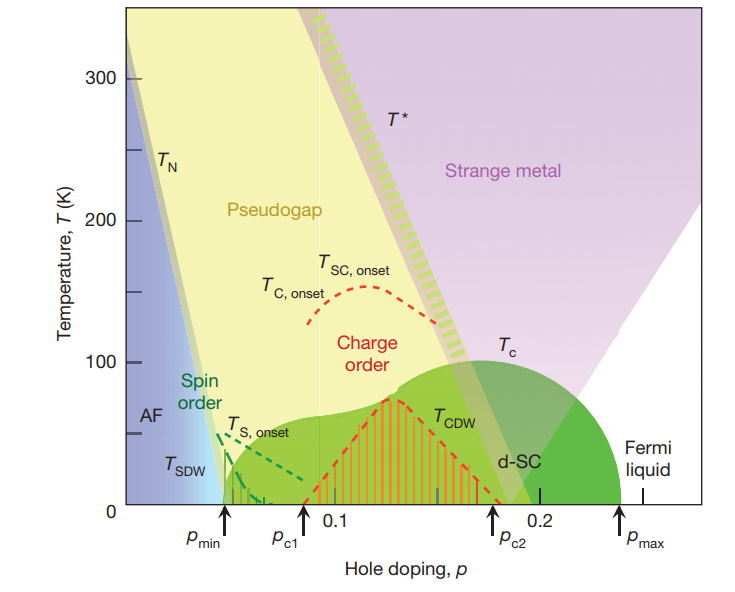
This work zooms in on one corner of that diagram: the parent state at zero doping
(
Where this subject goes next
The roadmap mirrors the thesis:
- The Hubbard model — the minimal model of reference for these materials, and its symmetries and Green’s functions.
- Its analytic limits — weak coupling (mean-field / Slater) and strong coupling (perturbation theory and superexchange).
- Dynamical Mean-Field Theory (DMFT) — a method that genuinely handles strong
correlation — and a numerical study of the MIT, compared against the classic Mott
system
.
Prerequisites
None — this is a good starting point.
Related in this subject
- The Hubbard ModelThe minimal model of reference for the cuprates — one hopping amplitude and one on-site repulsion — together with its particle–hole symmetry, Green's functions, and the two limits (atomic and non-interacting) that already reveal the Mott insulator.
- Weak Coupling: Mean-Field Theory and the Slater InsulatorStarting from the non-interacting limit, a mean-field decoupling of the Hubbard interaction with staggered magnetization gives an antiferromagnetic two-band insulator. Solving the self-consistent gap equation reveals a Slater gap that opens exponentially at weak coupling and crosses over to the Mott gap Δ → U/2 at strong coupling.
- Strong Coupling: Perturbation Theory and SuperexchangeIn the opposite limit U ≫ t, treating hopping as a perturbation and projecting out doubly occupied sites with a Schrieffer–Wolff transformation maps the half-filled Hubbard model onto the antiferromagnetic Heisenberg model, with superexchange J = 4t²/U.
- Dynamical Mean-Field Theory and the IPT SolverDMFT maps the Hubbard model onto a self-consistent Anderson impurity problem — exact in infinite dimensions — retaining the full frequency dependence of the self-energy that the perturbative limits miss. With Landau Fermi-liquid theory for interpretation and the Iterated Perturbation Theory solver for the impurity, it tracks the metal across to the Mott insulator in one framework.
- The Mott Transition in DMFT: Phase Diagram and V₂O₃Running the DMFT+IPT loop on the Bethe lattice traces the interaction-driven Mott transition — the three-peak spectral structure, the Fermi-liquid self-energy, the coexistence region with critical interactions U_c1 ≈ 2.54 and U_c2 ≈ 3.27, and a (U,T) phase diagram whose first-order line and critical endpoint reproduce the paramagnetic metal–insulator transition of V₂O₃.