Subjects
Each subject collects topics; each topic is a single page integrating theory, experiment, and computation.
Mott Physics in Correlated Lattices
A master's thesis in full — the cuprate puzzle, the Hubbard model, and the Mott metal–insulator transition through Dynamical Mean-Field Theory.
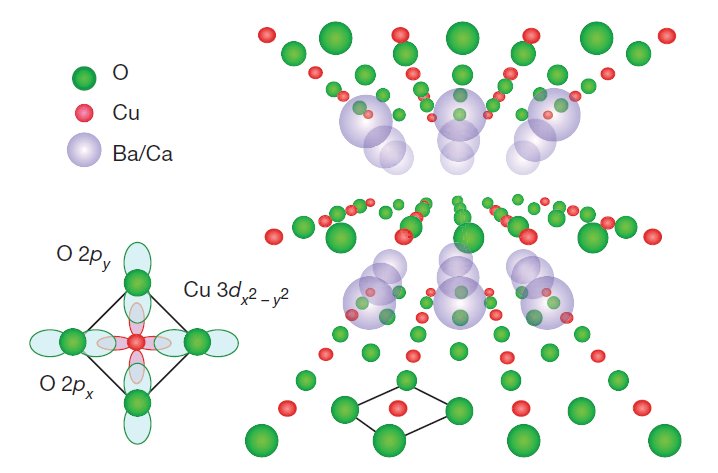
- Cuprates and the Mott Problem Why high-temperature superconductivity forced condensed-matter physics to take strong electron correlation seriously — and why the story begins with an insulator that band theory says should be a metal.
- The Hubbard Model The minimal model of reference for the cuprates — one hopping amplitude and one on-site repulsion — together with its particle–hole symmetry, Green's functions, and the two limits (atomic and non-interacting) that already reveal the Mott insulator.
- Weak Coupling: Mean-Field Theory and the Slater Insulator Starting from the non-interacting limit, a mean-field decoupling of the Hubbard interaction with staggered magnetization gives an antiferromagnetic two-band insulator. Solving the self-consistent gap equation reveals a Slater gap that opens exponentially at weak coupling and crosses over to the Mott gap Δ → U/2 at strong coupling.
- Strong Coupling: Perturbation Theory and Superexchange In the opposite limit U ≫ t, treating hopping as a perturbation and projecting out doubly occupied sites with a Schrieffer–Wolff transformation maps the half-filled Hubbard model onto the antiferromagnetic Heisenberg model, with superexchange J = 4t²/U.
- Dynamical Mean-Field Theory and the IPT Solver DMFT maps the Hubbard model onto a self-consistent Anderson impurity problem — exact in infinite dimensions — retaining the full frequency dependence of the self-energy that the perturbative limits miss. With Landau Fermi-liquid theory for interpretation and the Iterated Perturbation Theory solver for the impurity, it tracks the metal across to the Mott insulator in one framework.
- The Mott Transition in DMFT: Phase Diagram and V₂O₃ Running the DMFT+IPT loop on the Bethe lattice traces the interaction-driven Mott transition — the three-peak spectral structure, the Fermi-liquid self-energy, the coexistence region with critical interactions U_c1 ≈ 2.54 and U_c2 ≈ 3.27, and a (U,T) phase diagram whose first-order line and critical endpoint reproduce the paramagnetic metal–insulator transition of V₂O₃.