Dynamical Mean-Field Theory and the IPT Solver
DMFT maps the Hubbard model onto a self-consistent Anderson impurity problem — exact in infinite dimensions — retaining the full frequency dependence of the self-energy that the perturbative limits miss. With Landau Fermi-liquid theory for interpretation and the Iterated Perturbation Theory solver for the impurity, it tracks the metal across to the Mott insulator in one framework.
Methods Dynamical mean-field theoryIterated perturbation theory
Concepts QuasiparticlesStrong correlationsLocalization
On this page
Why a more sophisticated method, if we already have weak- and strong-coupling solutions? The weak-coupling mean-field gives an insulator only once antiferromagnetic order sets in — yet cuprates remain insulating above the Néel temperature (a paramagnetic Mott insulator), which that picture cannot explain. The strong-coupling expansion yields a Heisenberg model of localized spins but no itinerant/metallic behaviour. Both miss the intermediate-coupling regime, and crucially neither retains the frequency dependence of the self-energy — which governs quasiparticle lifetimes, spectral-weight transfer, and the Hubbard bands.
Dynamical Mean-Field Theory (DMFT) is a non-perturbative method that treats local quantum dynamics exactly while approximating spatial fluctuations — analogous to mean-field theory for the Ising model, or DFT. It tracks weak to strong coupling in one framework, putting metal and insulator on equal footing.
The DMFT mapping
The idea is to represent the lattice by a single local site coupled to an effective bath.
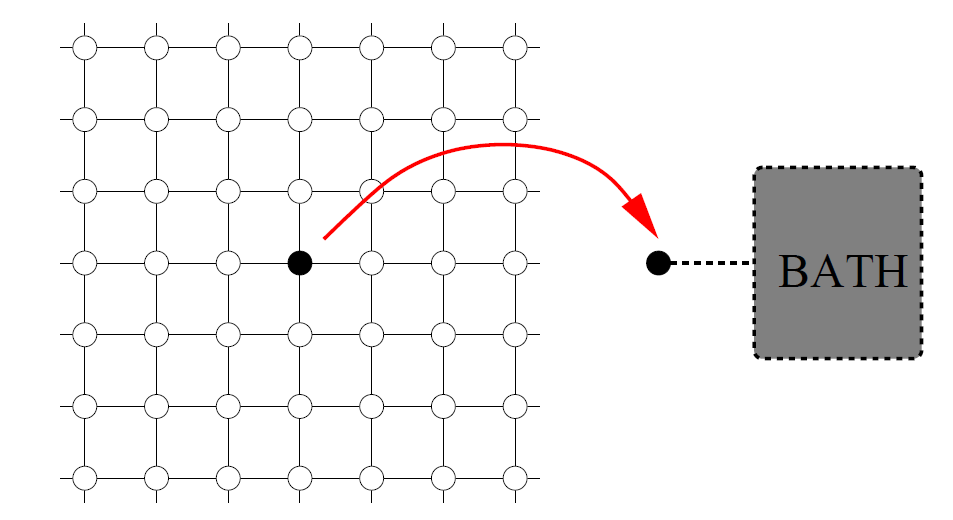
In the limit of infinite dimensions (large coordination
with
This is exact in infinite dimensions. Integrating out the bath gives the effective impurity action
where the Weiss dynamical field
For the lattice, the interacting Green’s function is
The key infinite-dimensional fact is that the self-energy is purely local, so
its
a closed self-consistent equation. With the non-interacting density of states
The DMFT loop
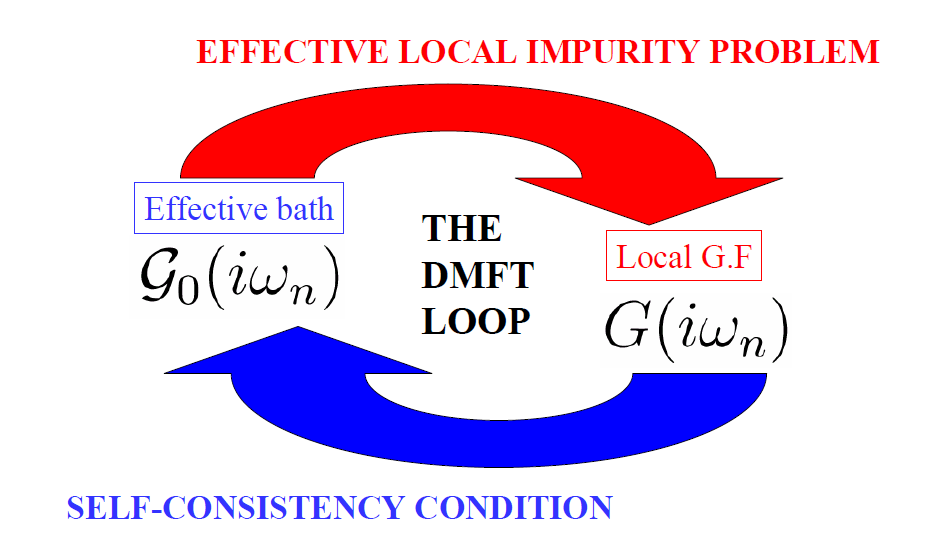
In practice DMFT iterates:
- Guess the Weiss field
. - Solve the impurity problem (an impurity solver) for
. - Get the self-energy from Dyson,
. - Compute
from the self-consistency condition. - Rebuild the Weiss field,
. - Repeat until
(and ) stop changing.
Landau Fermi-liquid theory
Landau’s idea: the low-energy excitations of an interacting Fermi system are long-lived, weakly interacting quasiparticles resembling those of a free Fermi gas, obtained by adiabatically switching on interactions,
Near the Fermi surface the scattering phase space vanishes, so quasiparticles become
long-lived (infinitely so at
(with
the spectral function is a Lorentzian of weight
a stable quasiparticle with renormalized dispersion and weight
and Cauchy’s identity again gives
The IPT solver
We use a simple, cheap impurity solver — Iterated Perturbation Theory (IPT) —
computing the self-energy to second order in
uses the Weiss field as the bare propagator
At half-filling, particle–hole symmetry
and the real part follows from the Kramers–Kronig relations (since
Model and lattice choice: the Bethe lattice
We take the single-band Hubbard model at half-filling in infinite dimensions
(
with the hopping rescaled so
The Bethe lattice idealizes real 3D compounds with large but finite coordination —
e.g. the corundum oxide
Prerequisites
- Weak Coupling: Mean-Field Theory and the Slater InsulatorStarting from the non-interacting limit, a mean-field decoupling of the Hubbard interaction with staggered magnetization gives an antiferromagnetic two-band insulator. Solving the self-consistent gap equation reveals a Slater gap that opens exponentially at weak coupling and crosses over to the Mott gap Δ → U/2 at strong coupling.
- Strong Coupling: Perturbation Theory and SuperexchangeIn the opposite limit U ≫ t, treating hopping as a perturbation and projecting out doubly occupied sites with a Schrieffer–Wolff transformation maps the half-filled Hubbard model onto the antiferromagnetic Heisenberg model, with superexchange J = 4t²/U.
Related in this subject
- Cuprates and the Mott ProblemWhy high-temperature superconductivity forced condensed-matter physics to take strong electron correlation seriously — and why the story begins with an insulator that band theory says should be a metal.
- The Hubbard ModelThe minimal model of reference for the cuprates — one hopping amplitude and one on-site repulsion — together with its particle–hole symmetry, Green's functions, and the two limits (atomic and non-interacting) that already reveal the Mott insulator.
- Weak Coupling: Mean-Field Theory and the Slater InsulatorStarting from the non-interacting limit, a mean-field decoupling of the Hubbard interaction with staggered magnetization gives an antiferromagnetic two-band insulator. Solving the self-consistent gap equation reveals a Slater gap that opens exponentially at weak coupling and crosses over to the Mott gap Δ → U/2 at strong coupling.
- Strong Coupling: Perturbation Theory and SuperexchangeIn the opposite limit U ≫ t, treating hopping as a perturbation and projecting out doubly occupied sites with a Schrieffer–Wolff transformation maps the half-filled Hubbard model onto the antiferromagnetic Heisenberg model, with superexchange J = 4t²/U.
- The Mott Transition in DMFT: Phase Diagram and V₂O₃Running the DMFT+IPT loop on the Bethe lattice traces the interaction-driven Mott transition — the three-peak spectral structure, the Fermi-liquid self-energy, the coexistence region with critical interactions U_c1 ≈ 2.54 and U_c2 ≈ 3.27, and a (U,T) phase diagram whose first-order line and critical endpoint reproduce the paramagnetic metal–insulator transition of V₂O₃.