The Hubbard Model
The minimal model of reference for the cuprates — one hopping amplitude and one on-site repulsion — together with its particle–hole symmetry, Green's functions, and the two limits (atomic and non-interacting) that already reveal the Mott insulator.
Methods Green's functionsTight binding
Concepts SymmetryQuasiparticlesLocalization
On this page
The Hubbard model is the standard theoretical framework for correlated electrons
in cuprates. It is a tight-binding model in which electrons are largely localized
on atomic sites and move only by tunnelling, with hopping amplitude
where the last term is the chemical potential
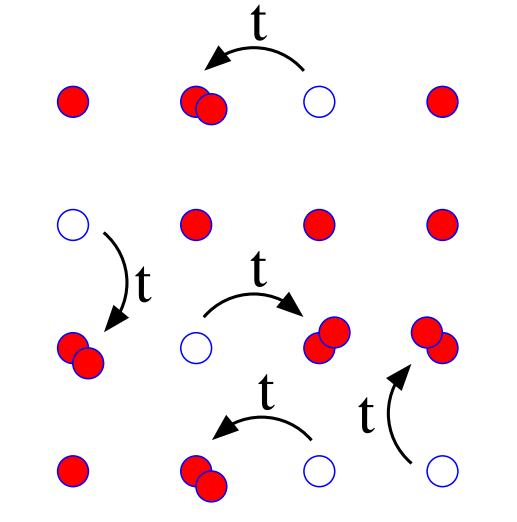
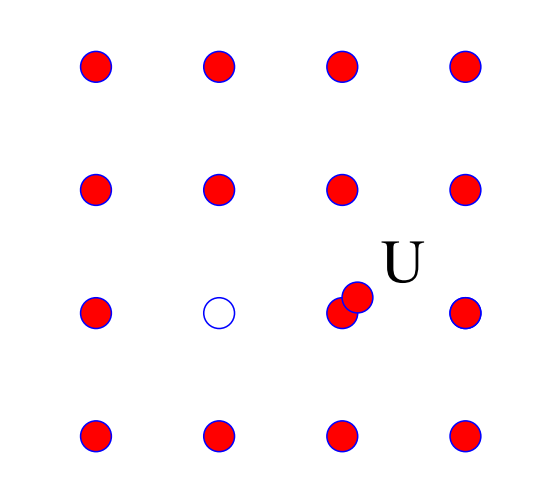
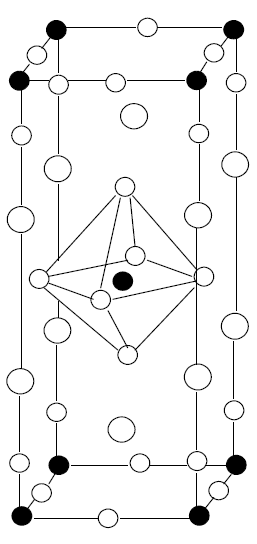
The justification: in-plane Cu–Cu distances are much shorter than the spacing to
the oxygen atoms in the insulating layers, so the essential physics happens within
the
Particle–hole symmetry
Bipartite lattices — such as the square and cubic lattices — split into two
sublattices
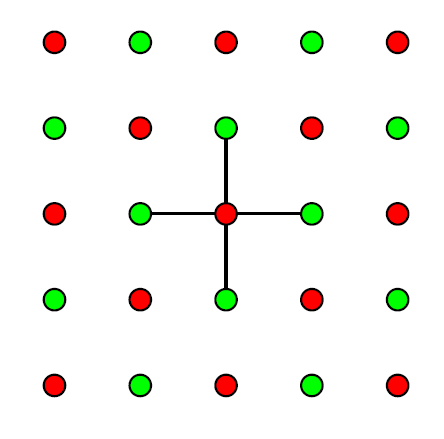
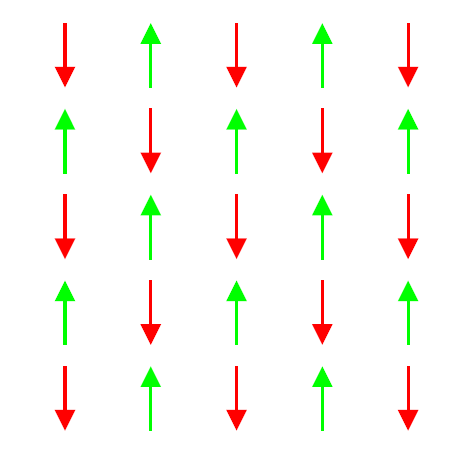
Introduce the particle–hole transformation (PHT):
The arrow means “replace the left operator by the right one in
The terms of the Hamiltonian therefore transform as
which differs from the standard form only by a shift of
In this form both kinetic and interaction terms are PHT-invariant; only the chemical-potential term changes sign (up to a constant),
so the Hamiltonian is PHT-invariant only at
PHT sends
That is,
Green’s functions
Green’s functions are the correlation functions at the centre of many-body theory.
Labelling the eigenstates of the full
where
and the expectation value is taken in the ground state (
The closely related spectral function, central to experimental observables, is
where
Here
The single-site (atomic) limit
To gain insight into the deceptively simple but analytically hard Hubbard model,
take
Here the number operators commute with
This is the atomic limit of the Anderson impurity model (AIM), describing an isolated ion:
where
Rewriting
the last term is a constant shift, and the two Hamiltonians coincide under
(first/second entry = number of spin-up/down electrons), with energies
Provided
The Mott insulator: an insight
Thermodynamics starts from the partition function
The four atomic-state energies, in Hubbard parameters, are
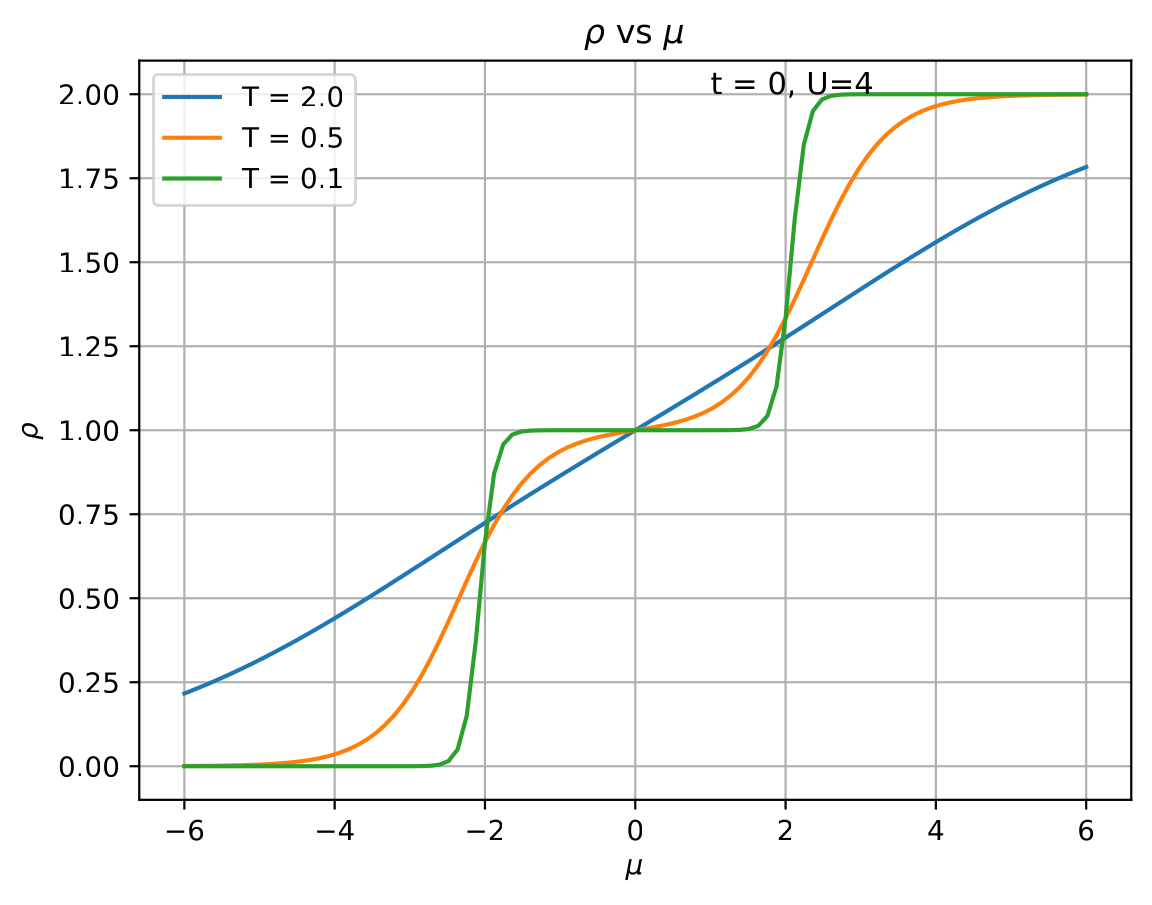
At
and the partition function becomes
The average occupation follows,
At
The spectral function (single site)
It is convenient to work on the imaginary axis and analytically continue to the real axis afterwards.
Imaginary-time approach. The Matsubara Green’s function is
with
Fourier transforming with
For fermions only odd Matsubara frequencies appear; using
Analytic continuation
and Cauchy’s identity
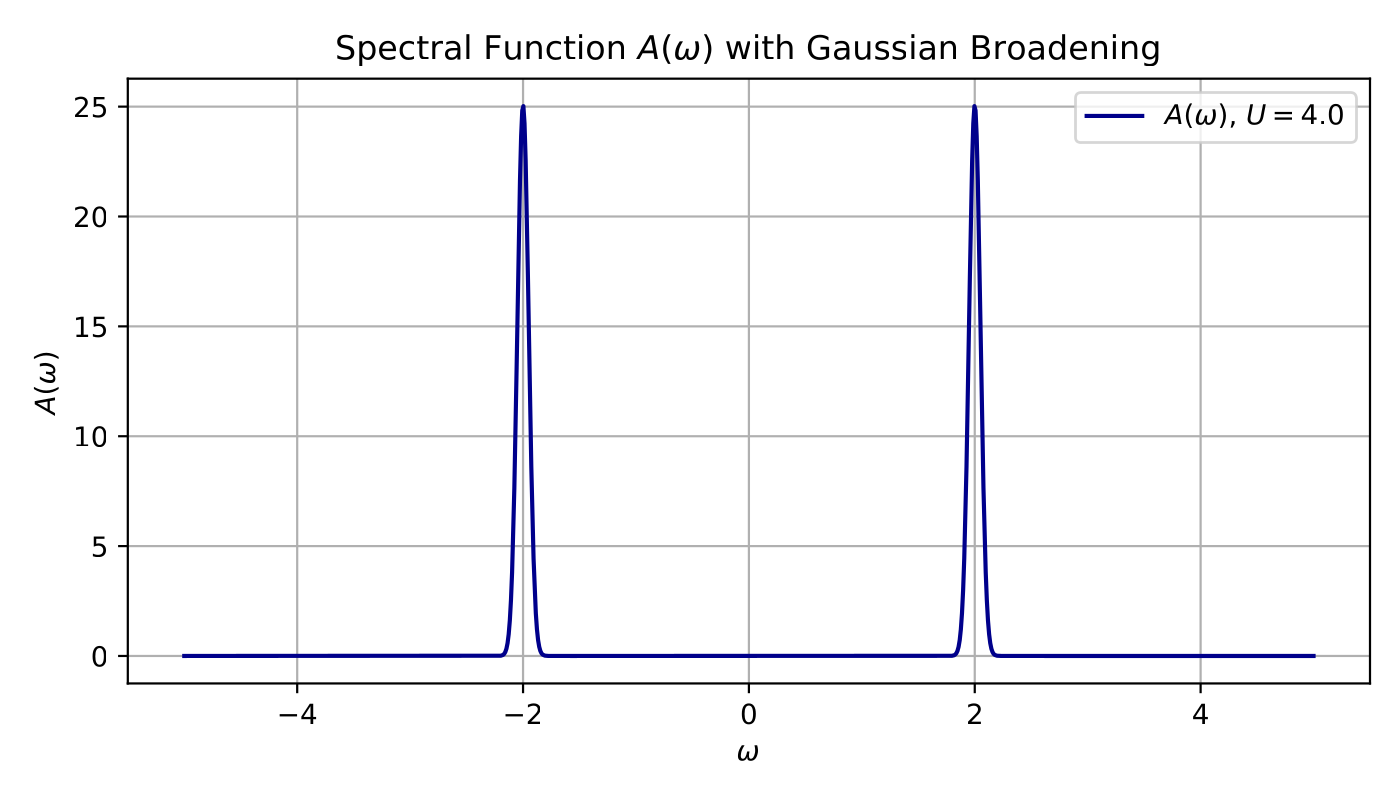
yields the spectral function
Lehmann representation. The same result follows from the Lehmann form, which
expresses
At
matching the earlier
Finally, the single-site spin-up occupation,
which
The non-interacting limit (
In the opposite limit the Hamiltonian reduces to tight-binding,
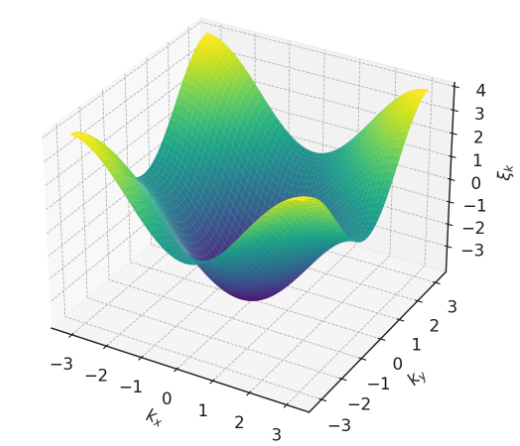
Lattice-translation invariance lets us diagonalize in momentum space,
Using
i.e. in compact form
with lattice constant
(with
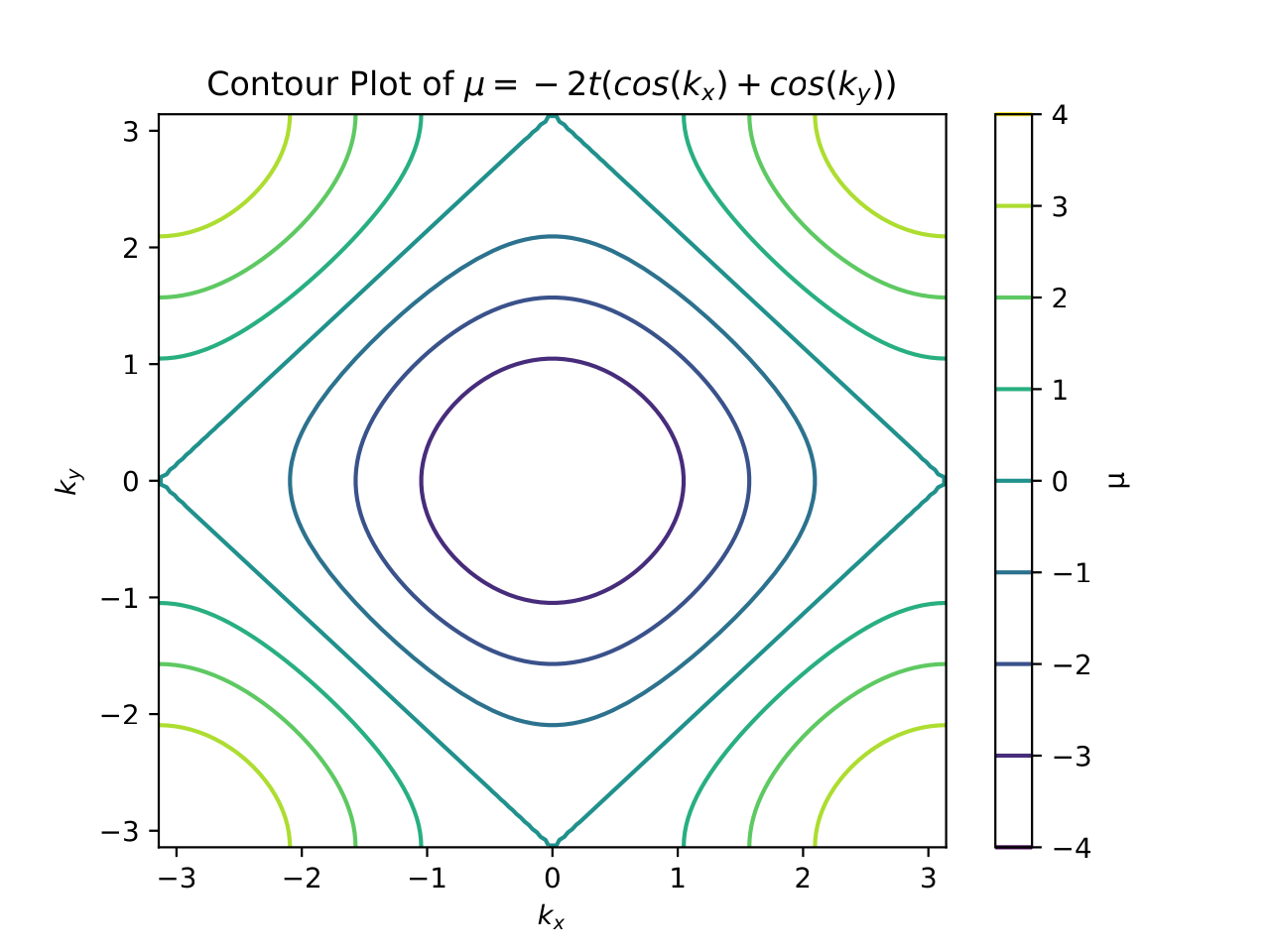
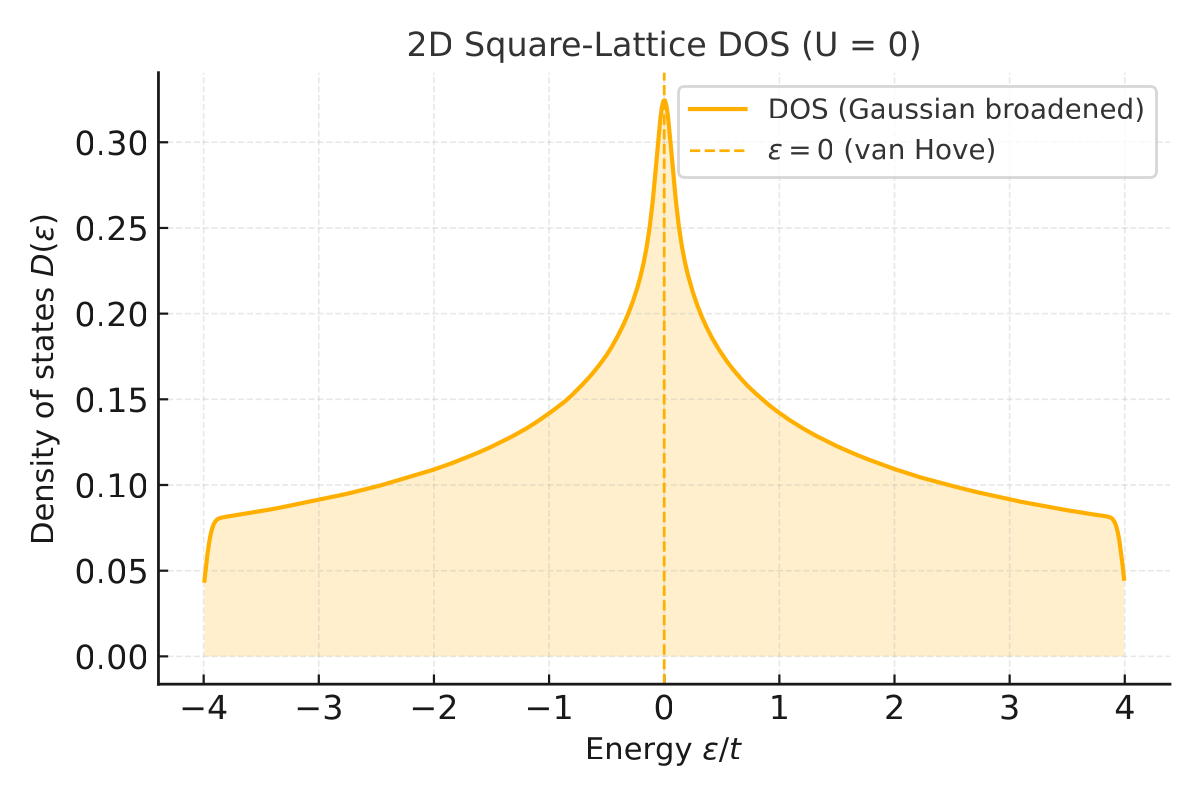
The Fermi surface
The spectral function (
The retarded Green’s function is
with spectral function
sharply peaked at the quasiparticle energy
Prerequisites
Related in this subject
- Cuprates and the Mott ProblemWhy high-temperature superconductivity forced condensed-matter physics to take strong electron correlation seriously — and why the story begins with an insulator that band theory says should be a metal.
- Weak Coupling: Mean-Field Theory and the Slater InsulatorStarting from the non-interacting limit, a mean-field decoupling of the Hubbard interaction with staggered magnetization gives an antiferromagnetic two-band insulator. Solving the self-consistent gap equation reveals a Slater gap that opens exponentially at weak coupling and crosses over to the Mott gap Δ → U/2 at strong coupling.
- Strong Coupling: Perturbation Theory and SuperexchangeIn the opposite limit U ≫ t, treating hopping as a perturbation and projecting out doubly occupied sites with a Schrieffer–Wolff transformation maps the half-filled Hubbard model onto the antiferromagnetic Heisenberg model, with superexchange J = 4t²/U.
- Dynamical Mean-Field Theory and the IPT SolverDMFT maps the Hubbard model onto a self-consistent Anderson impurity problem — exact in infinite dimensions — retaining the full frequency dependence of the self-energy that the perturbative limits miss. With Landau Fermi-liquid theory for interpretation and the Iterated Perturbation Theory solver for the impurity, it tracks the metal across to the Mott insulator in one framework.
- The Mott Transition in DMFT: Phase Diagram and V₂O₃Running the DMFT+IPT loop on the Bethe lattice traces the interaction-driven Mott transition — the three-peak spectral structure, the Fermi-liquid self-energy, the coexistence region with critical interactions U_c1 ≈ 2.54 and U_c2 ≈ 3.27, and a (U,T) phase diagram whose first-order line and critical endpoint reproduce the paramagnetic metal–insulator transition of V₂O₃.